Sunday, December 9, 2007

Your Majesty...


(Chapter 14, Question 1)

In Daniel 5, we read about King Belshazzar of Babylon and how he holds a great feast where he and his guests eat and drink using the silver from the Temple. As a result of the sacrilege of these sacred things, God delivered a message to Belshazzar, foretelling the near end of Belshazzar’s kingdom. Once again I ask the popular questions, “What is the meaning of this story and how does it apply to us”? Many times we do not realize the symbolism of the stories in the Old Testament that apply to our own lives today. The above story of Belshazzar applies to our respect towards sacred things such as the Holy Eucharist.

As Catholics, we may not realize the many graces which God has bestowed upon us. These graces he gives to us through many sacred things including the Eucharist. In the Eucharist God gives of his whole self to us. When we receive Jesus in the Eucharist, we are truly receiving His body, blood, soul, and divinity. Jesus in the Father and the Holy Spirit is actually present when the priest speaks the words of the Consecration.

Let us picture for a moment that you are in the chapel or just an ordinary room. In walks Jesus. He is standing before you, gazing at your face. This is God and He is in your midst only a few feet from where you are sitting. I don’t know what your reaction would be, but I think I would probably stare in shock and awe for a few moments before falling at His feet and pleading for forgiveness for every wrong I had ever done against Him, because He is so perfect and wonderful, and He loves me so much that He was gave his life for me. Every whip that tore at His flesh and every thorn that dug into His skull and the nails that were driven into his hands and feet are my sins laid against him. If you were the only person on the face of this earth, He would have been crucified just to save you.

Let us come back to the present. The priest has just spoken the words of the Consecration and has elevated the host which is now Jesus Christ present before you. What kind of respect will you show to him? We are not worthy to eat His Holy Flesh or drink His Holy Blood. Jesus is the one and only King. Before I came to JP Catholic, when I was about sixteen, I was talking to one of my godsisters after daily Mass. We were discussing how to properly dress for Mass. She explained it very well when she said, “When I go to Mass, I am presenting myself before Jesus who is God who is King. If I was going to see a king, I would put on my best gown, get my hair done, and wear my most expensive jewelry. How much more should I dress well before God who is King over the entire universe”. The same concept applies to our behavior. If we were to go before the Queen of England, we would never turn bow or curtsy or even kiss her royal hand. The same applies at Mass. Before receiving Communion, we are taught that we should bow or genuflect. God deserves much more than the Queen of England. He deserves our all.

So, before receiving the Eucharist, we should show the utmost respect for our King, the Lord Jesus Christ. Signs of respect show in our dress and in our behavior. How would you dress and behave before a king on earth? How much more should we do these things before God, who is our creator and King of the entire universe?

Saturday, December 8, 2007

Entertainment of the Night

cash advance

I did this a couple months back and it said my blog had a high school reading level. I guess this means I've improved.

Saturday, November 24, 2007

Wizards in Winter


One of my favorite songs called "Wizards in Winter". It is performed by the Trans Siberian Orchestra and has been coordinated with a Christmas light show.

Friday, November 23, 2007

God's Abounding Forgiveness and Mercy (Ch. 13, Qst. 1)

King Manasseh became king of Israel and Judah after the death of his father, Hezekiah. Manasseh was pure evil destroying every good thing his father had built up; building up high places, bringing back idols, and burning his own sons as sacrifices to pagan gods. This man was bad news.

However, all evil and wicked actions have reactions/consequences. In the case of Manessah, the consequences came in the event of the Assyrians swiftly attacking and conquering Jerusalem, carrying off Manessah in chains. This is when the evil king took a turn for the better and something amazing happened. Having lost all hope, the distressed Manessah humbled himself before God and prayed to him. God received him and brought him back to Jerusalem.

We can see in the course of Manessah’s action and God’s response the sacrament of reconciliation, which is the act of human beings asking God to forgive them after committing a fault. Manessah knew that he had lived a life of profound evil and placed himself in God’s hands, asking God to forgive him the faults he had committed. God listened to him and returned him to Jerusalem where Manessah tried to straighten out the mistakes he had made previously. He got rid of the foreign cults and the pagan altars and made sacrifices of Thanksgiving in the Temple. As a result of his conversion, he reigned over Israel and Judah longer than any king had before him.

The tie between Manessah’s turning to God a thoroughly evil kingship and the sacrament of reconciliation holds a strong meaning for us as Christians. Because of God’s unlimited love for us, if we detest and are profoundly sorry for our sins, God will forgive us our faults. This does not mean, however, that we can do anything we want, because of the knowledge that God will love us anyways and forgive us whenever necessary. I believe that would be considered taking advantage of God’s mercy. We are such sinners and already do not deserve God’s forgiveness as is. As humans, it is impossible to reach heaven without God. Testing God’s love for us is very treacherous, because God could unexpectedly end our lives.

Just as Manessah repented, we should also repent and we should do it as soon as we can and we shouldn’t wait until the last minute, because we never know when the end of our story will come. God is ready to forgive each and every one of us, no matter how grave the matter. In order for this to take place, we as God’s children need to place each moment of every day of our lives in His hands.

Don't Be Lazy! (Ch. 12, Qst. 1)

After reigning over Israel for forty years, King Solomon departed from this life into the next and kingship befell his son Rehoboam who had grown up in the court of his father and had known nothing but a life of luxury. Now Solomon had harshly reigned over his people, laying on them much suffering and difficult labor. When Solomon died, the elders came to his son asking if he might lighten their burden.

Sending them away, Rehoboam brought in his father’s counselors; some very wise old men. He asked how he should respond to the elders. They advised him to become a servant to his people and speak good words to them and if he did this he would be rewarded in that they would never leave him and always be his faithful servants. This advice did not sit well with Rehoboam, a man who had been accustomed to living a life of laziness in the grandness of the his father’s court. Hoping for an alternative, Rehoboam turned to the young men who befriended and grew up with him sharing in his idleness and wasting themselves away. Of course, being accustomed the same ways of living as their friend they told him to add more weight to the people’s burden. It was going to be worse for the people under the reign of Rehoboam than it had been under King Solomon! In making this decision, he was displaying a want of being more powerful than his father and proving it to the people under him by adding more weight to their already heavy burden.

The decision of Rehoboam resulted in disaster, but it also marks one of the seven capital sins – the sin of covetousness. The Catholic Encyclopedia states that this is not a grievous sin, except in certain conditions which involve offense of God or the neighbor. In other words, “when one is prepared to employ illicit or unjust means to satisfy the desire of riches”. Rehoboam was prepared to burden the people more heavily and to “chastise them with scorpions”. In doing this, he was refusing to serve them or to take some of their labor upon himself. They instead would work more in order that his riches and comfort in his vast halls would grow larger than they were in the reign of his father.

Besides the sin of covetousness, Rehoboam was also adding to his idleness almost to the point of slothfulness. He wanted to continue lying around in his court wasting his life away with his friends. The last thing he wanted to do was to take some of Israel’s work upon his own shoulders.

The lives of the people of Israel were made almost worse after King Solomon died and King Rehoboam took over. He succumbed to the evils of greed and slothfulness in order that he might be more comfortable in his court and keep his fair share of work down to a minimum. We can compare the sins of Rehoboam to two of the seven capital sins: covetousness and slothfulness. As human beings trying to conform ourselves to the perfection of God, we need to avoid these two sins that we might get along peaceably with our neighbors and be able to love God as he loves us by serving one another.

Wednesday, November 21, 2007

Howler Power


In case you are wondering, this is my dog Sam. He howls whenever I play my accordion, so my sister thought why not catch some live footage. You can hear me playing the set dance, "King of the Fairies" off screen.

(He mostly howls when I play in minor, which matches up with a study. Dogs are more likely to respond to music played in a minor key.) Enjoy the proof!

Tuesday, November 20, 2007

You Are Mashed Potatoes

Oridnary, comforting, and more than a little predictable
You're the glue that holds everyone together.

Saturday, November 17, 2007

Parents' Weekend!!!!!

It's that time of the month, or week, or day; the time to vent about how hectic things are at JP Catholic in the life of a sophomore (namely myself). So many projects (and classes, work study, and activities), so little time!

This weekend is Parents' Weekend; a time when students' parents come from all over the country to visit their "kids" for the weekend. My parents are from San Diego, but it's still exciting all the same. Yesterday, several parents came to observe classes. We all then ate an excellent lunch consisting of croissant sandwiches, apples, cookies, chips, soft drinks, and bottled water. Dr. Connolly gave his infamous talk about the school's three most important aspects: students, faculty, and benefactors. He pointed out with no subtlety at all whatsoever that if anyone had a million dollars burning a hole in their pocket, feel free to give it to the university.

At about 5pm, I went out to Island's with my family for dinner. My brother got the Big Wave, my dad got some sort of blue cheese burger, my sister and my mom got giant salads, and I got the Sunset Burger. We split a giant basket of fries with ranch dressing.

With full stomachs, my dad headed home (he's been working fifty hours a week) and the rest of us headed to Good Shepherd Parish for a talk given by Dr. Brant Pitre and Dr. Scott Hahn. Needless to say, they were AMAZING. I was trembling with excitement when we left.

Tonight is the 4th Annual John Paul the Great Catholic University Gala. Several of the students are going and we are supposed to mingle with the benefactors and have intelligent conversations until about 7pm. At that time, we will settle ourselves for a lovely dinner and listen to Dr. Connolly ask for money and listen to Joe Campo who is one of the head people working for Grassroots Films. We are actually supposed to see one of his films tomorrow. It will be an exciting night to say the least.

Aside from all this, I still have a lot of homework. I think to myself, as soon as I am finished with this huge project, things should get much easier. Of course, they don't. Oh well. This is the life of a college student. To think that I'm paying thousands of dollars a year to do all this homework and take lots of tests. I'd much rather just buy the degree.

That's all for now. The fun is about to begin!

Wednesday, November 7, 2007

The Ark of the Covenant of the Old Testament vs. The Tabernacle of Today (Chapter 10, Question 1)

As children of God, we are called to listen to his Word in the Bible and to learn from individuals such as the early prophets who provide examples for us through their successes and failures. We can learn from them because they are like us. They, like us, each had fallen natures and faults of their own. King David, “a man after God’s own heart”, was one of these individuals; a good man profoundly loved by God, but a man like us, who made mistakes, because he too had a fallen nature. In 2 Samuel 6, David tries to have the Ark of the Covenant brought to Jerusalem, but because he did not prepare properly, disaster came out of it. The Ark of the Covenant in the Old Testament is the Tabernacle of today, because God dwells within it. Therefore, the Ark needs to be treated with great respect. What special sacrament did God provide us with so that he might be present within us and what signs of respect should be shown towards that sacrament, whether it be in a Church or during the Mass?

2 Samuel 6 begins with David’s first attempt to bring the Ark of the Covenant to Jerusalem. His preparation is poor; a new cart pulled by oxen is their (David, and all the house of Israel) means of transportation for the Ark and the journey is arduous going over unstable terrain. “And when they came to the threshing floor of Nacon, Uzzah put his hand to the ark of God and took hold of it, for the oxen stumbled.” (2 Sam. 6:6) Uzzah died on the spot, for God had given specific instruction that no one who was unclean must touch the ark. The people of Israel had not prepared properly for the journey in that they had not cleansed themselves beforehand.

This story holds great meaning for Catholics, especially because of the great gift that God has given us in the sacrament of the Holy Eucharist. When receiving this sacrament, we are actually consuming the body, blood, soul, and Divinity of Jesus Christ in his entire being. He becomes truly present within us and because he is complete within each one of us, we become one body in Christ. It is one of the most important and precious mysteries in the Church.

Jesus is God and God is perfect. Therefore, when receiving Jesus, who is so great that no words could describe his greatness, it is important that we are in his good favor. When David decided to bring the Ark into Jerusalem, he failed to prepare the people. They were still unclean and when Uzzah touched the Ark he died. When communicants who are in a state of mortal sin receive Jesus in the Eucharist, it is an act of immense disrespect against God. This is a mortal sin in itself, and when we are in this state, we lose all sanctifying grace. We die spiritually and no longer are in communion with God. And if we physically die in this state, we are forever damned and separated from God. Before receiving the Eucharist, we must cleanse our souls by means of Confession.

When we enter a Church, the presence of the Tabernacle, or when we attend Mass, it is critical that we show respect for the presence of God in these places. For example, before entering a pew or receiving Jesus, we might bow or genuflect. In Queen Elizabeth’s presence we do these things as a sign of respect for her royal status. It would be considered very rude and inconsiderate if we forgot to bow, curtsy, or turned our back on her. She’s just the queen of England. God is King of all creation; the entire universe. Our respect for him should be one hundred times greater than for the queen of England.

The Ark of the Covenant from the Old Testament and the Tabernacle of today have similarities with one another. Both are dwelling places of God and they are two types of houses for Him in the midst of his children. Inside the Ark of the Covenant dwell three things: the Ten Commandments, Aaron’s rod, and the manna which was used to feed Israel for forty years in the desert. The manna is crucial when comparing the Tabernacle with the Ark. The manna was a flake like substance which tasted of honey and God commanded Moses to fill a container with the manna and to keep it as a memorial of how God fed the people of Israel in the wilderness. In the Tabernacle, we keep a container which holds the Eucharist in the appearance of unleavened bread (flat wafer-like substance). The Ark of the Covenant was overlaid with gold and made of the finest wood. The Tabernacle is also made with gold. The Bible also says that the Ark of the Covenant was like a tent. When the Tabernacle doors are opened, the priest draws aside a fine cloth.

As with the rest of the stories in the Bible, we can learn from the story of David’s journey with the Ark of the Covenant in the Old Testament and why it is so relevant to the Eucharist and the Tabernacle today. Since the Eucharist is indeed the entirety of Jesus Christ present in the most holy sacrifice of the altar, it is critical that we pay Him the respect that he deserves through our actions and by cleansing our souls. Otherwise, we will doom ourselves to an eternal fate of separation from God. We can also learn about the Tabernacle by reading this story, because there are so many similarities between the Ark and the Tabernacle. The story of the Ark traveling to Jerusalem holds many underlying meanings for us as Catholics and only if we meditate on it, will we find the messages that God is trying to convey to us.

Tuesday, October 30, 2007

The Rise and Fall of King Saul (Chapter 9, Question 3)


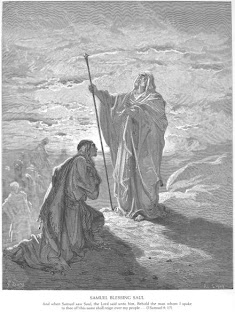
Most Christians who are familiar with the Bible are familiar with the story of Saul, the man who was chosen by God to be “prince” over God’s people Israel. Rejected by the people of Israel, God decided to rule through a new king. (For more info, go to 1 Sam. 8.) For this role, God chose Saul, a tall and handsome man from the tribe of Benjamin. So he led Samuel (the last of the Judges and the current leader of Israel) to Saul. Once there, Samuel poured a vial of oil over Saul’s head, thus anointing him to the position of king over the people of Israel.

Israel was in a state of war at this point and in a weak position to overcome the Philistines who had recently arrived from Palestine. They needed a leader to conquer their enemy; a king who would give them instruction.

Enter: King Saul, a king who was specifically chosen by God, the “anointed” one, the new savior of God’s people.

He magnificently subjugated the Ammonites which greatly pleased the people of Israel.

Delighted with his success, he next took on the Philistines. His power and victory had gone to his head, which often happens when people are placed in positions of royal authority. Saul was now king and wanted to lead rather than follow the will of God. When war raged between the Philistines and Israel, the latter began to lose. The people of Israel lost all hope. As a last resort, Saul made the decision to ask for God’s assistance. He was told by Samuel to wait at Gilgal for seven days, and then Samuel would come and offer sacrifices. When Samuel was a few days late, Saul grew impatient and decided to take matters into his own hands, offering sacrifices himself. Samuel was angered by Saul’s actions. Knowing full well that God was not pleased with his actions, Saul offered the sacrifices himself, not out of love for God, but because he wanted God to give him something in return. As punishment, Saul was told that his kingdom should not continue, that is, his son would not succeed him. Someone else would take his position in the line of royalty.

Saul made one more mistake that ended his kingship over Israel. God sent him on a mission to destroy Amalek, one of Israel’s most dangerous enemies. Saul was to leave nothing remaining of the Amaleks and their possessions even including the animals. This is where Saul made his second biggest mistake. Saul and his soldiers kept the best sheep, oxen, fatlings, lambs, and all that was good. All that was of no value was absolutely destroyed. This mistake was far worse than the first, because Saul had deliberately disobeyed God.

This is a much abbreviated version of King Saul’s rise and fall from kingship over the people of Israel. Although we can pull lessons from both mistakes made by Saul, I wish to address the first for the sake of the question.

To refresh our memories, Saul’s first mistake was when he offered sacrifices to God, thinking of it simply as a price to pay for something in return. In this case, he was paying for God to defeat the Philistines. Saul’s actions angered both God and Samuel, and he was told that his kingdom would not continue. Another man, not connected to Saul’s family line would take his place when he died. Saul was punished with loss of his future dynasty.

What lesson can we, hundreds of years later, pull from King Saul’s mistake? We should always act out of love for God and for each other, never doing gracious and loving things because of the reward we might receive. We should do it out of the kindness of our hearts, because we want what’s best for the other person. I will provide an example, with which I hope to better explain myself. Suppose I was to give one of my dearest friends an expensive gift. It would be the wrong attitude to expect a gift in return. The meaning of the gift would be of so much more value if I was to give it out of love for my friend, expecting nothing in return.

This lesson should be applied to our relationship with God. He gave us so much: a beautiful earth to live on with plants and animals. He gives us life and breath. He gave his life that we might be redeemed and one day live with him in eternal paradise. All he wants from us is that we love him with our whole soul, heart, and mind. He wants us to talk to him and frequently receive the sacraments which he so generously gave. We should love him for all these splendid things and expect nothing in return, because he has already given us so much! (Now, it is important that we ask God for things; that’s what he wants. At the same time, however, he wants us to pray in thanksgiving and with joyful hearts.)

In summary, we can learn from the mistakes that our predecessors made hundreds of years ago and use them to instruct us in the ways of our personal relationships with God who created us and loves us above all things. King Saul is one of these valuable examples. God expects us to praise him regularly in thanksgiving for all he has given us and he loves it when we ask him for things. King Saul, however, wasn’t honest about what he wanted. He offered God sacrifices because he wanted something in return. This was not an act of love, it was a selfish act and God saw the underlying truth.

Sunday, October 28, 2007

BELLA!

As many of my readers know, I was an intern over the summer marketing one of the most beautiful films I have seen in many years. "Bella", is now in theaters across the U.S., showing in five theaters in San Diego County. (Go to: www.bellathemovie.com
to find a theater near you.)

Today I saw the film for the second time and it took the same effect on me as it had the first. Movies do not usually stir much emotion in me, but "Bella" makes me laugh and brings me to tears.

Go see this lovely film as soon as you can (the sooner, the better), and let it touch your heart.

Saturday, October 27, 2007

This is When I'm Not in School

What Kind of Reader Are You?
Your Result: Dedicated Reader

You are always trying to find the time to get back to your book. You are convinced that the world would be a much better place if only everyone read more.

Obsessive-Compulsive Bookworm
Literate Good Citizen
Book Snob
Non-Reader
Fad Reader
What Kind of Reader Are You?

Wednesday, October 24, 2007

God's Will (Ch. 7, Question 1)


As many of my fellow JP Catholic students already know, or are figuring out, or will figure out (hopefully in the near future), our theology professor assigned a decent pile of reading for this week. When one is assigned so much homework, he/she tends to stop paying attention to what he/she is reading. For example, during my studies yesterday, I found myself at the end of some chapter in the Book of Exodus and realized that I had not been paying attention to the meaning of the words I had just read, which resulted in me having to go and read it again. (FYI, Lisa has just said, “Once upon a time, Andrea was doing her theology homework. When it came time to “blog”, she decided to clean her desk and then when she actually started writing, her first paragraph had nothing to do with anything at all.” I guess this means I should start writing something more useful and academic.)

“In the beginning, God created the heavens and the earth. The earth was without form and void, and darkness was upon the face of the deep and the spirit of God was moving over the face of the waters” (Gen. 1:1-2). This passage is taken from Genesis and for all of creation, it marks a crucial moment. For at this moment, God began to create the earth and all the inhabitants upon the earth including the animals, plants, and sea creatures. It was during this time that he also created mankind. He gave them dominion over the sea and the land and all its inhabitants. “…Have dominion over the fish of the sea and over the birds of the air and over every living thing that moves upon the earth” (Gen. 1:28). From the dawn of creation, God has always had a plan for each individual that he brings into the world.

Throughout the Old Testament, God made this clear for us through the example of the early prophets. In Exodus 3, God chose Moses to lead the Israelites out of slavery in Egypt. Moses, at that time was in Midian, keeping his father-in-law’s flock. In this story, God called out to Moses from a burning bush. He then told Moses of his plan for the Israelites. “I have seen the affliction of my people who are in Egypt, and have heard their cry because of their taskmasters; I know their sufferings, and I have come down to deliver them out of the hand of the Egyptians and to bring them up out of that land to a good and broad land” (Gen. 3:7-8). He went on to say, “Come, I will send you to Pharaoh that you may bring forth my people, the sons of Israel, out of Egypt” (Gen. 3:10).

In Exodus 4:1-17, Moses tried to convince God that he would not be able to free Israel. Moses first tried to convince God that the Israelites will not believe that the Lord appeared to him. God gave Moses two signs to show to the Israelites if they would not believe him and an additional sign if they would not believe after he showed the first two. Moses made a second excuse and said that he was not an eloquent speaker and that he was slow of speech and tongue. God told him that He would give him the guidance to know what he should say. Moses asked God to send another in his stead. Then God’s anger was “kindled against Moses” and He told him that Aaron (Moses’ brother) should go with him and that He Himself would speak through Moses and Aaron. Moses then went back to Egypt and through Moses, God delivered the Israelites out of Egypt towards the Promised Land.

In this story, God’s will was for Moses to lead the people of Israel out of slavery in Egypt. God has a plan for each of us as well. That is why he has brought each human being into the world; to fulfill his mission for us. I took a class third quarter of my freshman year in which the class read the Confessions of St. Augustine. In this book, St. Augustine wrote of his mother, St. Monica. She prayed for the conversion of her son her entire life. Shortly after his conversion, God ended her life. His will was for her to intercede for the soul of her son. Once he came back to God, God’s will for St. Monica was fulfilled.

More often than not, the path of God’s will is very difficult and is usually not without sacrifice, pain, and suffering. C.S. Lewis said, “We’re not necessarily doubting that God will do the best for us; we are wondering how painful the best will turn out to be.” However, if we always strive to follow the will of God, we can be assured that God will protect us under his wing.

In conclusion, God has a calling for each human being that he has created. His plan for Moses was to lead the Israelites out of slavery in Egypt to the Promised Land. The road was long and difficult and there were many obstacles in their way. His plan for us may be difficult, but we must trust that he will lead us in the right direction and that he will protect us in the face of evil as he did for Moses and the Israelites.

Monday, October 22, 2007

PLEASE PRAY!

Well, as many of you know, there is a fire raging throughout San Diego right now. My parents called me at 6:50am (luckily I was already awake) and my dad told me that this fire is big news and that it is racing towards the beach. Several big homeschooling families we know have evacuated their homes and my family is facing the possibility of leaving as well.

Please pray for all the evacuees. I probably won't be exiting the apartment today; my family might need to come here.

BTW, I think this is one of the shortest posts I've ever written.

Sunday, October 14, 2007

SOS (Chapter 6, Question 1)

Here I am, once again, on a chilly Sunday evening, typing. Normally, I try to avoid doing anything related with homework on this important day of the week, but I am more behind then I would like to be, so I figured, “Why not do my theology homework? It is the Lord’s Day after all and we read Scripture every Sunday.” So, after attending the 12:15pm Mass and eating some lunch, I delved into my theology textbook.

The second chapter illustrated the story of Isaac and his two sons, Esau and Jacob. (Jacob later fathered twelve sons who were ancestors of the twelve tribes of Israel.) Esau and Jacob were twins. Esau was born first and was Isaac’s favorite, while Jacob, born shortly after his brother, was his mother’s favorite. As Isaac’s first-born son, Esau was automatically given the responsibility of one day becoming head of the family and was entitled to a double share of the inheritance.

In Genesis 25, however, we read the story of how Esau sold this birthright to his younger brother. Jacob is boiling pottage when his brother comes in tired and starving after a long day of work in the field. Before Jacob feeds him, however, he makes his elder brother swear to sell him his birthright. Esau agrees, because of his hunger, and sells his birthright to Jacob.

The characteristics and weaknesses of these two young men come out strongly in this one event. Esau doesn’t take his birthright seriously and gives up his important role as Isaac’s first-born son for the sake of satisfying his hunger. Jacob, on the other hand, becomes manipulative in this situation, sees his brother’s weakness, and takes the initiative. Scott Hahn points out that Esau thinks only of his present desire; what he wants at that particular moment, while Jacob thinks of the long term.

When we read this story, we might think, “Why did Esau sell his valuable birthright to his brother over a simple bowl of porridge? That was not wise in the least. I would never have done something as stupid as that.” Would you really have been smarter than Esau? Let us move forward in time to the era of slavery, a time when people had ownership over others and could sell them as if they were merely objects. What was the underlying goal in this situation? The goal was to fulfill a desire of greed. When slaves were sold, their “owners” received money in return.

Another example might prove to be useful; one which might be related to the story of the two brothers above. Gluttony, as you might recall from a previous post, is one of the seven deadly sins and for good reason. It is a point of weakness and desire which we succumb to all the time.

One way to overcome our sins is to come to know ourselves better along with our faults. The better we know our faults, the better we can know what tempts us and pulls us into a state of sin. As our creator, God knows us better than we know ourselves, so he has provided us with a means of becoming strong in him that we might be better prepared the next time we are tempted to sin.

The human race falls into a state of sin repetitiously because of we have a fallen nature due to original sin. For this reason, Christ gave the Church certain sacraments to aid us in our continual struggle against sin. When we are baptized, we enter into unity with Christ, who died for our sins and rose for our justification (CCC pg. 867). It is our first means of forgiveness and when we are baptized we receive the remission of original and personal sin. Once we reach the age of reason, we receive the sacrament of Reconciliation which is one of two sacraments of healing. This sacrament is truly beautiful, because when we sincerely confess our sins, God, through the priest, fully forgives all the wrong we have done. The third sacrament received is that of Holy Communion. In this sacrament, the body, blood, soul, and divinity of Christ enter into us in the appearance of bread and wine. When we receive Jesus in this manner, all our venial sins are wiped away. Confirmation completes the grace of Baptism and we become more perfectly bound to the Church and are enriched with a special strength of the Holy Spirit (CCC 1286). The last sacrament is the second sacrament of healing and the last one given to us before we die. The Anointing of the Sick is administered by a priest to a baptized person who begins to be in danger of death because of illness or old age, through prayer and the anointing of the body wit the oil of the sick (CCC pg.866). This sacrament includes a special grace of healing and comfort to the Christian who is suffering the infirmities of serious illness or old age and the forgiving of the person’s sins (CCC pg. 866). God gave the Church these five sacraments as a means of overcoming sin so that we might enter into eternal life with him.

Through the use of Scripture, and in this case the story of Esau and Jacob, God establishes lessons that we can take and apply to our own lives. Esau and Jacob show us that the human race is weak when up against our desires. But God knows our weaknesses and he strengthens us when we fall through the grace of the sacraments.

Thursday, October 11, 2007

Wash For Life!

About a week or so before I came back to JP Catholic, I was fortunate enough to be able to participate in the 2nd Annual Wash For Life. Wash For Life was started a couple years ago by a group of Thomas Aquinas College (TAC) graduates who decided to raise money for Pregnancy Centers in the United States by washing cars. Several of these events take place all over the US.

Last year, I was sadly incapable of supporting this awesome project, because I was moving into my apartment at JP Catholic. So, this year I tried to make it up by spending four hours of my Saturday washing cars in Poway, CA. It was an awesome experience! We had a continuous line of cars to wash and pretty much all of our customers made a donation. We received a couple $100 checks, several $40 checks and there was much generosity going around. One teenage girl who clearly needed to take better care of her appearance donated to our cause not even knowing what she was donating too. I gladly explained to her what we were raising money for and showed her some pictures of the Life Choices Pregnancy Center that we had up on display. The highlight of the day was when we washed a huge semi. I believe it was one of those big orange moving trucks. Another semi driver driving down the road and Mr. Cunningham (who was running the whole thing) paid him $5.00 to keep driving.

Of course, as with pretty much every car wash including a lot of kids, we had an occasional water fight initiated by the one with the hose and we entertained ourselves by occasionally splatting someone on the back with a soapy, soaking wet sponge. I remember a particular rascally someone coming towards me, while holding a very heavy sponge (with water) in their right hand, and asked for a truce. Their plan was to squeeze the sponge, if I was stupid enough to take it.

There are several great pictures from this event, so I thought I would post a couple. The first was taken by my long time family friend/Confirmation sponsor in Oklahoma. I have a link to her blog on the side bar. You can find her through the mystical rose link.


Oklahoma


Washing the Semi in Poway


Quizzler

I found this quiz on a family friend's blog and I thought it would be fun to it post on mine as well:

1. Do you attend the Traditional Latin Mass or the Novus Ordo?
Answer: Novus Ordo.

2. If you attend the TLM, how far do you drive to get there?
Answer: 45 minutes

3. If you had to apply a Catholic label to yourself, what would it be?
Answer: Does being a Catholic home schooler work?

4. Are you a comment junkie?
Answer: Yes, I guess.

5. Do you go back to read the comments on the blogs you’ve commented on?
Answer: When I remember.

6. Have you ever left an anonymous comment on another blog?
Answer: Once, when I had no other choice.

7. Which blogroll would you most like to be on?
Answer: I don't really care.

8. Which blog is the first one you check?
Answer: jpstudent.blogspot.com or echoesofcreation.blogspot.com.

9. Have you met any other bloggers in person?
Answer: Definitely. MK, Shelle Belle, Rebekah, Kevin, Ria, Alisha, all my classmates, Martin Harold, Professor Barber, and many, many others.

10. What are you reading?
Answer: Currently, I am working through several school books, and when I get the chance to read it, which isn't very often, "Fear Nothing" by Dean Koontz. Unfortunately and fortunately, because of the school books, I haven't had time for much else.

Saturday, October 6, 2007

Cain, Abel, Euthanasia, and Abortion (Chapter 4, Question 1)

Well, here I am, once again writing another blog post. I hope you enjoyed my two previous posts on St. Therese of Lisieux and the Guardian Angel prayer.

This evening I would like to touch on two of the top most serious issues in the world today which have to do the value and the dignity of human life. These issues and rather sensitive subjects are none other than euthanasia and abortion. Since, the title of my blog does mean beautiful truth which has to do with God's Word, please allow me to reach back into history - Biblical history.

In the beginning, that is in Genesis 4, we read the story of the two sons of Adam and Eve, Cain and Abel. The two brothers each offered a sacrifice to God. "Cain brought an offering of the fruit of the ground, and Abel brought some of the firstlings of his flock and of their fat portions." (Gen. 4:3-4) God had regard for Abel's offering, but not for that of his brother. At the end of Gen. 4, Cain murders his brother Abel. God, in his wrath, punishes Cain severely by banishing him from the land and his descendants were caught up in sin and violence.

Now, you might ask, why did God punish Cain so severely for murdering his brother? Due to much pondering, I came up with an answer/opinion. There are seven deadly sins (also called the Cardinal Sins): lust, gluttony, greed, sloth, wrath, envy, and pride. Cain first fell into sin when he was envious of his brother. Envy led Cain to murder Abel. He also broke the sixth Commandment, "Thou shall not kill". He committed a mortal sin.

When a human being commits a mortal sin, there are serious consequences; not just in the eyes of the law, but in the eyes of God as well. When we commit mortal sin we lose sanctifying grace and are separated from God. Cain was separated from God when he murdered Abel. And he was sent to the land of Nod. You might say that we are offered the sacrament of reconciliation where we confess our sin and are completely forgiven. Why wasn't Cain offered this chance? He was. God asked him where Abel was. God, who sees and knows everything, knew perfectly well where Abel was, but he offered Cain the chance to admit his wrongdoing (just as he had offered Adam and Eve). But Cain lied to God and didn't admit his sin. Notice the resemblance between Cain and his parents. The apple doesn't fall far from the tree. (That was a lousy attempt at a pun.)

Cain has a long line of descendants who all fall into sin. Lamech is a major figure in the line. He is the first one in the record to have two wives (polygamy) and he doesn't even love them as people. He treats them as objects. He kills other men out of revenge and with no respect for the fact that they are created in God's image and likeness.

This brings me to the two serious issues I mentioned in the beginning of this post. The world has little respect for the dignity and value of human lives. This is sort of off on a tangent, but I took a class from Fr. Francis (a Norbertine priest that some of you may know) for three years. He drilled into our heads just this:

"My human dignity consists in five things: God the Father created me in his image, God the Son redeemed me, God the Holy Spirit sanctified me, and God called me to be a member of his Church. My human dignity consists in doing what is morally good."

I think that if more people followed this way of thinking they would have more respect for themselves as well as for other people. Professor Barber has told us several times (and he is absolutely correct), "God is willing for you to be existing and sitting in this room right now. If he didn't will you to exist, you would vanish." What right do we, as merely human beings, who wouldn't even be here if he didn't will us to, have to take away a human life. That is not our job to be taking a way someone else's precious life. When we do via euthanasia and abortion we are taking away someone's life a.k.a. murdering a human being who was made in God's image and likeness. They, like us, are part of God's family. God has sent each one of us here for a purpose; he has a very special plan for you, me, everyone. "We are on a mission from God!"

Remember what happened to Cain when he murdered his brother. He was banished from the land. If we commit murder, we too will be banished from the land, from God's land. We will be banished from his eternal kingdom and will be consumed in pain and suffering.

We all have fallen natures, but nevertheless, we should strive to be perfect as God is perfect and conform ourselves to his will. If we do this, there is less of a likelihood for us to fall into sin.

Tuesday, October 2, 2007

Prayer to Your Guardian Angel


Angel of God,
my Guardian dear.
To whom God's love
commits me here,
Ever this day,
be at my side,
To light and guard,
Rule and guide.
Amen.

Monday, October 1, 2007

St. Therese of Lisieux


"I understood, too, that our Lord's love is revealed as perfectly in the most simple soul...as in the most excellent soul...The nature of love is to humble one's self...Everything is grace." ~ St. Therese of Lisieux